
1 | Chapter 1 — The Bed I Wasn’t Allowed to Keep
By the time I got back to our room, my face still felt tight from smiling at people I barely knew and pretending the whole day had not hollowed me out.
The wedding had gone on for hours. There had been red envelopes, sticky rice, forced laughter, too many toasts, and Vivienne watching everything like a judge pretending to be a mother. I had spent half the afternoon carrying plates, answering questions, and smoothing over small disasters with the kind of politeness that makes your jaw ache. I told myself that once the guests were gone, once the last auntie had collected her favors and the music had faded, I would finally be allowed to breathe beside my husband.
That was the fantasy I walked into our room with.
I had just taken out my earrings when the door opened.
Adrian stood there first, one hand braced on the frame, his tie loosened, his expression apologetic in the way men sometimes use when they have already decided they will not change their mind.
Behind him came Vivienne.
She was supposed to be downstairs, making one of her impossible speeches, but she was swaying theatrically, one hand pressed to her temple, a pillow tucked under her arm like she had been rescued from a storm. Her lipstick was a little smudged. Her blouse hung slightly crooked. She smelled strongly of alcohol, or at least enough like it for anyone who did not want to look too closely.
Adrian cleared his throat. âMom is too drunk. Let her lie down for a while. Itâs too noisy downstairs.â
I stared at him. Then at her.
Vivienne blinked at me slowly, as if my face were a light she found inconvenient. âIâm just tired,â she murmured, with a softness that did not match the sharpness of her eyes.
I took a step forward out of instinct, ready to guide her to the living room couch or call for water. This was our wedding night. Even if I had been exhausted, I still understood what belonged in a bridal room and what did not.
But Adrian put himself between us.
âDonât make this difficult,â he said, low enough that only I could hear. âLet Mom lie down here. Itâs only one night.â
Only one night.
I felt the words hit harder because he said them on our wedding night, as if that detail should somehow make the request reasonable. As if surrendering my bed was a small kindness I should be grateful to provide.
Vivienne swayed again and looked at me through half-lowered lashes, already performing the role of the frail elder. I knew her well enough by then to know that she could turn weakness on and off depending on who was watching. She had spent the entire engagement season correcting my posture, my clothes, my tone, my way of serving tea. Now she wanted my bed.
I smiled because there were guests downstairs, because my own mother had raised me to keep my dignity quiet, and because I could already hear the word rude waiting to be used against me if I resisted.
âOf course,â I said.
Adrianâs shoulders eased immediately, which told me more than his words had.
I took the extra pillow from the bed, carried it to the sofa, and did not look back when Vivienne lowered herself onto the sheets I had just arranged that morning. I told myself I was being generous. I told myself good daughters-in-law did not start wars on the first night.
But generosity did not keep me warm.
I lay on the sofa with my wedding jewelry still sitting on the dresser, listening to the house settle around me. The music downstairs faded. Someone laughed too loudly in the hall, then quieted. Upstairs, the floorboards creaked above my head.
Once.
Twice.
Then steady pacing.
I opened my eyes and stared at the ceiling. At first I thought Vivienne was restless. Then I thought perhaps Adrian had gone to check on her. But the steps continued, slow and deliberate, crossing the room above me and back again. Not the stumbling rhythm of a drunk woman. Not the heavy crash of someone truly passed out. More like a person waiting. Thinking. Arranging something in the dark.
Then silence.
I dozed in broken pieces after that, waking every time the room changed temperature or a door shifted somewhere in the hall. By the time the sky began to pale at the edges of the curtains, my body felt raw with exhaustion.
At nearly six, I finally gave up pretending I would sleep.
I went upstairs quietly, intending to wake Adrian so we could greet my relatives before anyone started asking why the bride had disappeared. The hallway was dim and cold. The bedroom door stood slightly ajar.
I pushed it open.
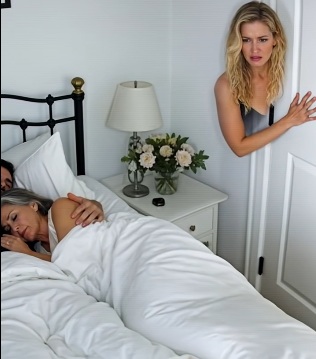
Adrian was on his back in the bed, one arm flung out, his face slack with sleep. Vivienne lay very close to him on the same sheet, her body angled toward his as if the night had folded them into an arrangement that belonged to no one else.
My throat tightened.
Then I saw the sheet.
At first it was only a pale mark against the white cotton, a smear I could not place. I moved closer and realized it was lipstick, fresh and bright, dragged across the fabric in a narrow curve. Near it, caught in the weave, was a torn scrap of lace from Vivienneâs cuff, the delicate thread snagged hard enough to fray.
Not the work of a woman too drunk to stand. Not the mark of a harmless mistake.
It looked placed. Left behind.
My hand went cold around the doorknob. Every careful excuse I had built for the night began to crack in one ugly line.
Vivienneâs eyes opened.
Not hazily. Not slowly.
She looked fully awake, and perfectly aware of me.
Then, in a calm voice that made my skin prickle, she said, âSince youâre awake, we should discuss family responsibilities before breakfast.â
2 | Chapter 2 — What They Expected Me to Sign
I did not scream. That was the first thing that surprised me about myself.
Vivienne’s eyes were clear now, too clear for a woman who had supposedly been too drunk to lie anywhere except my wedding bed. She adjusted the blanket with lazy precision, as if she had woken from an ordinary night’s sleep instead of from the scene that had turned my stomach cold.
«Since you’re awake,» she said, her voice smooth and almost cheerful, «we should discuss family responsibilities before breakfast.»
Family responsibilities.
I looked at the lipstick smear on the white sheet again, at the torn scrap of lace still caught in the fabric, and felt something inside me shift. Not break. Harden.
I lowered my eyes like an obedient bride, but I pulled my phone from my robe pocket and snapped two quick photos before stepping back. One of the stain. One of the lace. My hand barely shook.
Adrian stirred beside her and opened his eyes with the heavy, annoyed expression of a man who wanted inconvenience to disappear before he had to name it. He looked from his mother to me and sat up too quickly.
«Lena, it’s not what it looks like.»
People always said that when they had already decided what it looked like was my problem.
«What does it look like?» I asked quietly.
Neither of them answered. Vivienne only gave me a thin smile, the kind people wore when they believed they were still in control of the room.
At breakfast, she performed perfectly. Her hair was brushed. Her lipstick had been reapplied in a muted rose, almost innocent. Her blouse was buttoned properly now, and she even laughed once, lightly, as though last night had been a harmless family inconvenience instead of a deliberate humiliation.
«My head is terrible this morning,» she told Adrian’s aunt, pressing two fingers to her temple. «I don’t know what came over me.»
Aunt Celia, who missed nothing, raised one eyebrow but said nothing. I noticed that.
Adrian sat beside me and kept trying to touch my wrist under the table, small secret gestures meant to calm me down without forcing him to actually explain anything. I moved my hand each time. Across from us, Vivienne buttered toast with steady fingers.
Then she changed the subject with surgical timing.
«After brunch,» she said, as if mentioning flowers or weather, «we’ll take care of the household papers. It is better to settle these things while everyone is still together.»
My fork stopped halfway to my mouth. «What papers?»
She smiled at me over her teacup. «Nothing complicated. Just routine family matters. Access, signatures, practical things. You are Adrian’s wife now. We don’t separate these concerns in this family.»
Adrian finally spoke, too fast. «It’s standard. Mom likes everything organized.»
Standard.
A strange heat climbed my neck. In that moment, small things I had ignored over the last six months returned to me with cruel clarity. Vivienne asking how much my late father had left me «for security.» Adrian casually suggesting that after the wedding we could «merge responsibilities.» The way he had once asked whether the apartment my father left me was fully in my name, then laughed and called himself curious when I hesitated. At the time, I had smoothed each moment over in my mind because love made me embarrassed by my own caution.
Now those memories arranged themselves into a shape I could no longer avoid.
I excused myself after breakfast and went to the back hallway where the staff moved trays and folded linens out of sight of the guests. The housekeeper, Nola, had worked for Vivienne for years. She was careful, quiet, and knew how to survive people like her.
«Nola,» I asked softly, «was Madame very ill last night?»
She glanced toward the dining room before answering. «Ill, no.»
«Drunk?»
Her mouth tightened. «She drank less than most of the guests.»
I felt my pulse in my throat. «Are you sure?»
«I brought the coffee service upstairs after midnight,» she whispered. «She was standing in the corridor herself. Perfectly steady. She told me everyone was to leave that floor alone.»
For a second, the hallway seemed to tilt. I grabbed the edge of the console table to steady myself.
So I had not imagined the pacing. She had been walking. Waiting. Positioning everything.
Not collapsing.
Not helpless.
Staging.
By the time I returned to my room, the humiliation of the morning had begun to transform into something colder and more useful. They had not done this just to insult me. Vivienne did not waste cruelty. She invested it.
That was when I understood the point of the bed.
If I had stormed downstairs accusing my husband and his mother of something disgusting, I would have looked unstable on the morning after my wedding. If I had stayed silent, I would have looked ashamed. Either way, I would have been off balance, eager to avoid scandal, eager to be told how to behave, eager to prove I could be gracious and loyal and worthy of being accepted.
Easier to direct.
Easier to pressure.
Easier to make sign whatever «routine family matters» they put in front of me.
I hated how neatly it fit.
I was still standing there, replaying every word from breakfast, when I heard the shower running in the bathroom down the hall. Adrian had left his phone on the side table near the window, screen dark, careless for once.
I told myself not to look.
Then the screen lit up.
Just one message preview, bright against the dim room. From Vivienne.
After she sees the bed, she’ll stop arguing.
3 | Chapter 3 — The Messages They Never Thought I’d Read
The moment I saw that message preview flash across Adrian’s phone, something inside me went cold in a way anger never could. Anger burned fast. This was different. This was the feeling of a floor giving way under your feet while your face stayed perfectly still.
«After she sees the bed, she’ll stop arguing.»
I did not touch the phone immediately. My hands were shaking too much, and I knew that one stupid mistake could warn him. Instead, I memorized the exact wording, turned away, and excused myself to the powder room with the kind of small, polite smile women wear when they are expected to keep a family gathering smooth. The second the door closed behind me, I locked it and called the one person I trusted to think clearly when I couldn’t.
Mara picked up on the second ring.
«I need you,» I said.
She didn’t waste time asking whether it was serious. «Send me your location.»
Within forty minutes she was in the hotel café across from the estate, wearing jeans and a plain white shirt, looking so normal that it nearly made me cry. I told her everything from the forced bedroom switch to the lipstick stain, the torn lace, Nola’s comments, the breakfast talk about signatures, and the message preview on Adrian’s phone. Mara listened without interrupting, her mouth growing tighter with each detail.
When I finished, she leaned forward and said quietly, «Lena, this wasn’t humiliation by accident. This was setup with an objective.»
«I know,» I whispered. «I just need to prove it before they put papers in front of me.»
Mara was better than I was at thinking in sequence. She took out her notebook and made me go over the timing again: when Vivienne entered my room, when I heard footsteps overhead, when Nola saw her steady in the corridor, when breakfast began, when Adrian left his phone unattended. Once it was all lined up, the shape of it became harder to deny. They had not simply behaved indecently. They had coordinated.
Mara knew one more thing: Adrian was lazy with passwords. A year earlier, when he had asked me to order something from his email while he drove, I had seen him type the same date he used for almost everything. It made me feel sick that I still remembered it.
When Adrian stepped away during the pre-brunch bustle to greet a distant uncle at the front gate, his phone was again left charging on the console table in the sitting room. My pulse hammered so loudly I thought it might fill the whole house. Mara stood by the doorway, talking lightly to one of my cousins to keep the space from emptying too noticeably, while I crossed the room, lifted the phone, and entered the date.
It opened on the first try.
What hurt most was not the messages from Vivienne. It was how ordinary Adrian sounded in reply.
Not shocked. Not trapped. Not ashamed.
In one thread, sent just before midnight, Vivienne had written: «Bring her downstairs. Let me have the room. She still thinks marriage gives her equal footing.»
Adrian had answered: «One night of discomfort will make tomorrow easier. She resists less when she’s embarrassed.»
I stared until the words blurred.
There were more.
«Keep mentioning responsibility,» Vivienne wrote at 6:12 a.m. «She’s proud. If she feels she’s already made a scene, she’ll sign to restore peace.»
Adrian: «I’ve prepared the folder. Don’t mention my loans unless necessary. Frame it as temporary authority and joint protection.»
My stomach dropped so sharply I had to grip the edge of the table. Loans. That word alone explained too many things at once: his recent tension, his sudden urgency about «merging futures,» the strange insistence that legal paperwork was romantic because marriage meant trust.
I sent screenshots to Mara, then searched his email. There it was: a scanned document package attached to a message from a family attorney. The first pages were dressed in soft language about efficiency, estate coordination, and spousal convenience. But buried inside were clauses that would grant Adrian signing authority over matters linked to my late father’s rental property. Another section tied me as secondary guarantor to a debt restructure involving his business account. If I signed that folder smiling at brunch, I would be carrying liabilities I had never agreed to and handing access to assets my father had protected for me all his life.
For one brief second, I couldn’t breathe.
This had never been about family harmony. The bed, the fake drunkenness, the morning shame, the talk about being respectful, being mature, being a proper wife. They had tried to make me smaller before putting a pen in my hand.
Mara read the screenshots as I forwarded them, then called me immediately.
«You leave now,» she said. «You go to your mother, to a lawyer, to anyone. Right now.»
I looked through the sitting room doors toward the lawn where staff were arranging white flowers around the brunch tables. Relatives were already gathering, laughing, taking photos, telling each other how beautiful the wedding had been. If I walked out quietly, Vivienne would cry, Adrian would act wounded, and by tonight I would be the unstable bride who misunderstood routine documents and ruined her own marriage over jealousy.
«No,» I said, surprising even myself with how steady I sounded. «If I leave in silence, they keep the story.»
Mara was quiet for a beat. Then she asked, «So what are you going to do?»
I looked at the screenshots, the clauses, the timestamps, the neat trail they had never imagined I would see.
«I’m going to let them hand me the folder,» I said. «And then I’m going to make them explain every word in front of everyone.»
By the time brunch began, I had printed the screenshots from the business center, forwarded the document package to a private email, and saved the sheet photos into three separate folders. My fear was still there, but it had changed shape. It was no longer the fear of being called rude. It was the sharp, clean fear that comes right before you stop obeying.
I took my seat.
A server poured coffee. Silverware chimed softly against china. Around me, conversations floated like nothing in the world was wrong.
Then a leather folder was placed beside my plate.
Vivienne laid one hand over mine, smiled for the guests, and said, «Now that you’re part of this family, let’s make it official.»
4 | Chapter 4 — The Bride Who Refused to Be Cornered
When the folder was placed beside my plate, I finally understood how carefully they had timed everything.
The garden brunch looked beautiful from a distance. White roses. Crystal glasses. Soft music. My relatives were smiling for photos, Adrianâs aunts were passing pastries, and Vivienne sat at the head of the table in pale silk, elegant and composed, as if she had not spent the previous night in my bridal bed. If I had stayed silent, that scene would have swallowed me whole. I would have signed while everyone watched, too ashamed to raise my head.
Vivienne touched the folder with two polished fingers and smiled at me as though she were offering jewelry.
âNow that youâre part of this family,â she said lightly, âletâs make it official.â
Adrian gave me the look he had worn all morning: gentle on the surface, hard underneath. The look of a man who thought pressure counted as leadership.
I did not touch the pen.
Instead, I stood up.
The scrape of my chair against the stone patio cut through the music. Several heads turned. Mara, seated near the end of the table, looked straight at me and gave the smallest nod. My mother had gone still. She knew my face well enough to understand that something had already broken.
âIâd like everyone to hear something before I sign anything,â I said.
Vivienneâs smile thinned. âLena, this is not the time.â
âNo,â I said, and for the first time since entering that house, I did not lower my voice to make anyone comfortable. âThis is exactly the time.â
The table fell silent.
I picked up the folder and held it closed in both hands. My palms were steady. That surprised even me.
âLast night, on my wedding night, I was told to give up my bed because Vivienne was supposedly too drunk to rest anywhere else. I slept on the sofa because I didnât want to be called disrespectful on the first night of my marriage.â I looked around the table, at the faces that had laughed and toasted us only hours before. âThis morning, I went upstairs and found my husband in bed with his mother lying beside him.â
A few people inhaled sharply. Someone set down a spoon.
Vivienneâs face changed first, not into shame, but irritation. âWhat a disgusting way to twist a family misunderstanding.â
I took out my phone.
âThen letâs not rely on misunderstanding.â
I opened the photos and turned the screen outward. âThis was the sheet.â The lipstick smear showed bright against the white fabric. Then the second photo: the torn scrap of lace caught in the bedding. âThis was from Vivienneâs cuff.â
One of Adrianâs older cousins actually leaned forward to look. His aunt covered her mouth.
Vivienne gave a short, brittle laugh. âYou photographed bed linen? Honestly, Lena, you are behaving hysterically.â
âHysterical?â I said. âNola saw you walking steadily after midnight. She told me you ordered the staff to leave the upstairs floor alone. You were not too drunk to stand. You were not too drunk to plan.â
Adrian rose halfway from his chair. âEnough. Youâre embarrassing everyone.â
That was the moment I had been waiting for. Not because he stood up for me. Because he did not.
I switched to the screenshots.
âHere is a message from Vivienne to Adrian,â I said, reading clearly enough for the whole table to hear. ââAfter she sees the bed, sheâll stop arguing.ââ
No one spoke.
I looked at Adrian while I read the next one. ââOne night of discomfort will make tomorrow easier. She resists less when sheâs embarrassed.ââ
My own voice almost failed me on that line, not because I was uncertain, but because hearing his cruelty out loud stripped away the last lie I had told myself about him. He had not been weak. He had not been trapped between two women. He had walked me into humiliation like it was strategy.
Vivienne stood abruptly. âThat phone was private. You had no right.â
âAnd you had no right,â I said, âto stage a degrading scene on my wedding night so I would be too shaken to read these papers properly.â
I opened the folder and pulled out the flagged pages Mara and I had marked before brunch.
âThis document gives Adrian authority connected to my late fatherâs property. This clause makes me a secondary guarantor for his debt restructuring. This wasnât family formality. This was a trap.â
My uncle reached for the pages. Then my mother. Then one of Adrianâs own relatives asked, very quietly, âDebt restructuring?â
Adrianâs face drained. âLena, I was going to explain that later.â
âAfter I signed?â I asked.
He had no answer.
The room turned then. Not dramatically, not all at once, but decisively. People stopped pretending this was a quarrel between difficult women. They started reading. Looking. Calculating. Vivienne kept trying to speak over me, calling me unstable, ungrateful, malicious. But every word landed weaker than the last, because evidence has a cruel clarity. It leaves no place for performance.
I placed the folder back on the table.
âThis marriage is over before it truly began,â I said. âI will not sign anything. I will not stay in a house where humiliation is used as discipline. And I will not carry shame for what the two of you planned.â
My mother stood immediately. Mara was beside me a second later. Behind them came my uncle, then my cousin, then, unexpectedly, Adrianâs older aunt, who looked at Vivienne with naked disgust.
Adrian reached for my wrist. âDonât do this over one mistake.â
I stepped back before he could touch me.
âNo,â I said. âIâm doing this because it was never one mistake. It was a plan.â
I left in my wedding dress.
By sunset, I was in my motherâs home with a lawyer on speakerphone, copies of every message backed up in three places, and written instructions to freeze any access to my accounts and property documents. Within days, the annulment process began. The family attorney who had prepared the papers sent a nervous explanation once he realized what he had been dragged into. I kept that too.
For the first few days, I thought the worst part would be the scandal. I was wrong. The worst part had been the silence I almost chose. Once I spoke, the fear lost its shape.
People did talk, of course. They always do. But they did not talk about me the way Vivienne had intended. They talked about the messages. The fake drunkenness. The debt. The bed. The papers. Adrian stopped calling after my lawyer replied. Vivienne sent one final message accusing me of destroying her sonâs future. I deleted it without answering.
She was wrong about one thing.
I had saved my own.
Months later, when I could finally sleep through the night without hearing footsteps in my head, I understood what that morning had really given me. Not trauma alone. Proof. A clean, brutal truth before my life could be tied to theirs beyond repair.
I had entered that house as a bride trying to be accepted.
I left it as a woman who finally understood that dignity was not something other people granted me when I behaved well enough.
It was something I had to protect myself.
And this time, I did.