
My Son Tried to Take My House and Left Me Bruised. By Breakfast, the Fourth Chair at My Table Had Destroyed Every Lie He’d Built.219

Daniel expected to find me frightened the morning after he tried to take my house.
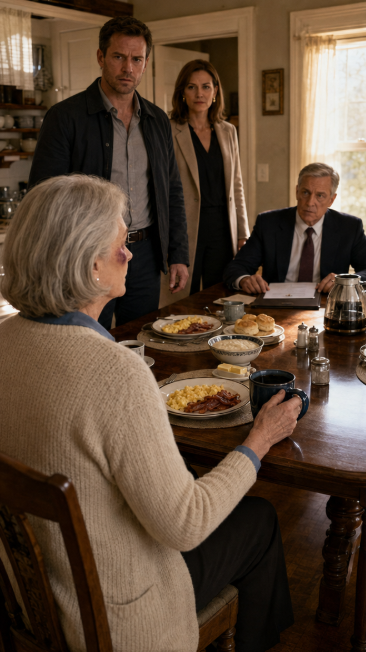
Instead, he found breakfast for four.
The biscuits were still steaming when he walked into my kitchen at 8:15. Bacon crackled softly on a warming plate. A bowl of yellow stone-ground grits sat beneath the little blue-striped towel Robert had bought in Savannah years ago because he claimed food tasted better when it was covered by something cheerful.
Sunlight came through the lace curtains above the sink and fell across the old oak table where my husband and I had eaten almost every breakfast of our thirty-eight-year marriage.
Daniel stopped in the doorway.
His wife, Marissa, almost walked into his back.
For one quiet second, my son simply stared at me.
His eyes went straight to the bruise beneath my left eye.
It had darkened overnight.
Purple at the center. Blue around the edges. Tender enough that even the warmth from my coffee made the skin ache.
Then Daniel looked at the breakfast.
Something in his shoulders relaxed.
He thought he understood.
He thought the eggs, biscuits and good china meant surrender.
“So,” he said. “You finally learned.”
Marissa stepped around him.
She wore a camel-colored coat over black trousers, her chestnut hair smooth around her shoulders. There was a faint smile on her face, the kind a person wears when the outcome of a difficult negotiation has gone exactly as planned.
“This could have been much easier, Linda.”
I lifted Robert’s blue coffee mug.
I took a sip.
Then I said, “Sit down, Daniel.”
He frowned.
That was when he noticed the fourth chair.
A gray-haired man in a dark navy suit was already sitting at the far end of my table.
In front of him lay the same folder Daniel had slammed onto my coffee table the night before.
Beside it sat a tablet.
On the tablet was a frozen image from my living room security camera.
Daniel could see himself in it.
One hand gripping my arm.
The other raised.
My body twisted away.
The exact second before his hand struck my face.
Daniel’s color disappeared.
Marissa’s smile vanished with it.
The gray-haired man rested one hand on the folder.
“Good morning, Daniel.”
Daniel stared.
“What is this?”
The man opened the folder.
I placed my coffee mug carefully into its saucer.
“You wanted paperwork,” I said.
The man looked directly at my son.
“You’re going to get it.”
The story of how we reached that breakfast table did not begin the night Daniel hit me.
I wish it had.
It would have been easier to understand.
Cruelty is simpler when it arrives suddenly. You can point to the moment before and the moment after and know precisely where everything changed.
Families rarely break that cleanly.
They wear thin.
A favor becomes an expectation.
An expectation becomes entitlement.
Entitlement becomes resentment.
And one day, someone you once carried sleeping from the car looks at the home where you raised him and sees not memories, not sacrifice, not love, but an asset he believes should already belong to him.
My name is Linda Hale.
I was sixty-eight years old when my only son decided I had lived independently long enough.
The house sat on Maplewood Drive, five miles outside Charleston, South Carolina. It was not a mansion. It did not have marble floors or iron gates or a swimming pool.
It had three bedrooms, a deep front porch, pale yellow siding and an enormous live oak in the backyard that Robert spent twenty years threatening to trim and never did.
We bought it in 1988 for $112,000.
At the time, it felt like an impossible amount of money.
Robert was thirty-one and worked for a regional building supply company. I was twenty-nine and handled billing at a dental practice. Daniel was not born yet.
We signed papers at a folding table in a lawyer’s office and spent our first night in the house sleeping on a mattress on the floor because the moving truck had broken down outside Columbia.
Robert opened a bottle of cheap champagne with a screwdriver.
“We own walls,” he told me.
“We own debt.”
“Same thing, but more optimistic.”
That was Robert.
He could make a mortgage sound romantic.
Daniel was born two years later.
His first steps happened between the kitchen and the dining room.
His height was marked in pencil inside the pantry door.
His sixth birthday party ended with chocolate frosting ground into the living room carpet.
His first girlfriend stood crying on our porch when they broke up at seventeen.
Robert taught him to shave in the upstairs bathroom.
I sat with him at the kitchen table when his first business failed.
Robert died in our bedroom when he was sixty-seven.
Pancreatic cancer.
Seven months from diagnosis to the final morning.
Afterward, people asked whether I planned to move.
I understood why.
A house can become very large when only one person remains in it.
But I never felt alone there.
I felt surrounded.
Robert’s jacket still hung on the hook beside the garage for almost a year because I could not bring myself to move it.
His handwriting was on labels in the workshop.
His coffee stains remained inside that ridiculous blue mug because the glaze had cracked and absorbed years of mornings.
There were scratches on the hallway floor from Daniel’s toy trucks.
A dent in the dining room wall from the Thanksgiving when Robert opened a bottle of sparkling wine indoors despite my explicit warning.
The house was not real estate to me.
It was the physical evidence that my life had happened.
Daniel knew that.
At least, I believed he did.
For the first year after Robert’s death, my son called almost every evening.
“Did you eat?”
“Yes.”
“What?”
“Food.”
“Mom.”
“Daniel, I survived raising you. I can make soup.”
He would laugh.
Sometimes he came over on Saturdays to change air-conditioning filters, check smoke alarms or complain about the weeds growing between the patio stones.
Marissa usually came with him.
She and Daniel had been married six years by then.
When I first met her, I thought she was exactly what Daniel needed.
Organized.
Confident.
Ambitious.
She worked in commercial property management and understood contracts, financing and investments in ways Daniel never seemed interested in understanding.
Daniel had always been a dreamer.
He could see a business that did not exist yet and become completely convinced it would succeed.
That quality had once made me proud.
It also made him dangerous to himself.
At twenty-eight, he opened a specialty coffee shop with two friends.
It closed fourteen months later.
At thirty-three, he invested in a fitness studio.
The partners fought.
At thirty-seven, he started a home-renovation company.
That one almost worked.
Then labor prices increased, two large clients refused final payment and Daniel began using credit cards to cover payroll.
Robert and I helped.
Not once.
Several times.
I never counted the exact amount because counting would have turned help into debt, and I did not want my relationship with my son to become an account ledger.
Robert was less sentimental.
“You keep rescuing him,” he told me once, “and one day he’ll forget he was ever drowning.”
I became angry.
“He’s our son.”
“I know exactly who he is.”
“That sounds terrible.”
“No. It sounds like a father.”
At the time, I thought Robert was being hard.
After he died, Daniel’s problems grew.
At first, the requests were small.
Five thousand dollars to cover equipment.
Three thousand for a supplier.
A temporary loan for insurance premiums.
Then there was the morning Marissa came to my house alone.
She sat exactly where I later sat with the bruise beneath my eye.
“Linda, I need to talk to you about Daniel.”
My chest tightened immediately.
“Is he sick?”
“No.”
“Is someone hurt?”
“No.”
She sighed.
“He owes more than he’s telling you.”
I waited.
“How much?”
“About one hundred and eighty thousand.”
I actually laughed.
Not because it was funny.
Because sometimes your body makes a sound before your mind understands what it has heard.
“That isn’t possible.”
“It is.”
“How?”
“Credit lines. Business cards. Vendor debt. A private loan.”
“Why would anyone give him a private loan?”
Marissa looked toward the window.
“That’s complicated.”
I remember that phrase.
I would hear it many times.
That’s complicated.
It became a curtain people pulled over facts they did not want me examining too closely.
“What do you want me to do?” I asked.
She hesitated just long enough to make the next sentence seem reluctant.
“The house is paid off.”
I looked at her.
She continued quickly.
“You have enormous equity. You could take out a home equity line. We’d make the payments.”
“No.”
She blinked.
“Linda—”
“No.”
“I don’t think you understand.”
“I understand perfectly.”
“Daniel could lose his company.”
“Then Daniel could lose his company.”
Her face changed.
Only slightly.
But I saw it.
Until then, she had believed my affection for my son was a lever.
That morning, she discovered it had limits.
“This would devastate him.”
“I watched my husband die seven months ago. Daniel will survive a failed business.”
“That’s cold.”
“No, Marissa. Cold would be letting him build another year of debt because everyone around him is afraid to let him fail.”
She stood.
“I thought you cared.”
I stood too.
“Do not use that sentence on me again.”
She left without saying goodbye.
Daniel called three hours later.
“What did you say to Marissa?”
“The truth.”
“She was trying to help.”
“She asked me to borrow against my home.”
“For me.”
“Yes.”
“And you said no.”
“Yes.”
There was a long silence.
Then he said something I would remember later.
“Dad would have helped.”
That hurt.
He knew it would.
I closed my eyes.
“Your father told me repeatedly to stop paying for your mistakes.”
Daniel said nothing.
I wished, immediately, that I could take the sentence back.
Not because it was false.
Because Robert was dead, and the dead should not be dragged into arguments they cannot leave.
Daniel hung up.
For nearly three weeks, he did not call.
Eventually, he returned.
There was no apology.
There rarely was anymore.
Instead, we performed one of those strange family rituals where people behave normally until normal behavior becomes a substitute for forgiveness.
He brought barbecue.
I made potato salad.
Marissa complimented my hydrangeas.
We moved forward without resolving anything.
That was the first mistake.
The second was continuing to help.
I paid one overdue tax bill for Daniel’s company.
Then I covered a medical deductible after he tore his shoulder.
At Christmas, I gave him and Marissa fifteen thousand dollars because he told me they were trying to refinance their home.
Generosity had been the language of my motherhood for almost forty years.
I cooked.
I paid.
I showed up.
I forgave.
I did not understand that every time I solved a problem without demanding accountability, Daniel learned a different lesson than the one I intended to teach.
He learned that my resources were family resources.
Then he learned that my boundaries were negotiable.
Eventually, he learned to interpret the word no as an obstacle rather than an answer.
The change happened gradually.
He began making comments about the house.
“You should really sell while prices are high.”
“You don’t need three bedrooms.”
“That yard is too much for you.”
“What if you fall when nobody’s here?”
“You’d love one of those new senior communities.”
At first, I laughed.
“I’m sixty-eight, Daniel. Not a museum exhibit.”
“They have pools.”
“I have a bathtub.”
“Mom.”
“I’m staying.”
Marissa approached differently.
She sent links.
Luxury retirement communities.
Townhouses.
Condominiums.
One place had something called a “wellness concierge.”
I replied that I already had a doctor.
She stopped sending links.
Then, six months before the night everything changed, Daniel asked a question over Sunday dinner.
“What happens to the house when you die?”
My fork stopped halfway to my mouth.
Marissa looked at him.
“Daniel.”
“What? We should talk about these things.”
I placed my fork down.
“It’s handled.”
“How?”
“My estate is handled.”
“I’m your only child.”
“Yes.”
“So why won’t you tell me?”
“Because I’m alive.”
He pushed back from the table.
“This is exactly what I’m talking about. You treat me like I’m some stranger.”
“No. I treat my financial affairs as private.”
“We’re family.”
“That does not make my bank account a group discussion.”
Marissa touched his arm.
“Let it go.”
He did.
But the look on his face frightened me.
Not anger.
Calculation.
That night, after they left, I walked upstairs to Robert’s desk.
I had not used it much since his death.
His fountain pen remained in the second drawer. Old invoices were stacked beneath a leather writing pad. The faint smell of cedar still clung to the cabinet.
I found the estate binder in the bottom drawer.
It was thick.
Trust documents.
Insurance policies.
Property records.
I had signed dozens of papers during Robert’s illness and after his death. Some I understood. Others I trusted our attorney to explain.
The attorney was a man named Elliott Mercer.
Gray hair.
Dark suits.
A voice so calm it made everyone else lower theirs.
He had known Robert for twenty-six years.
Elliott had handled the purchase of a commercial parcel Robert once owned with a partner, Daniel’s first incorporation paperwork, our wills and eventually Robert’s estate.
After Robert died, Elliott told me, “If anyone ever pressures you about money, call me before you sign anything.”
I thought he was being thorough.
Six months later, sitting alone at Robert’s desk, I remembered that sentence.
I called him the next morning.
“Daniel asked what happens to the house when I die.”
Elliott was silent for a moment.
“What exactly did he say?”
I told him.
“Has he asked you to sign anything?”
“No.”
“Borrow anything?”
“Marissa did, last year.”
“Against the house?”
“Yes.”
Another pause.
“Linda, I want you to promise me something.”
“What?”
“If either of them brings you paperwork concerning the house, do not sign it.”
“I wasn’t planning to.”
“I mean do not even write notes on it. Don’t initial anything. Don’t give them a copy of your identification. Call me.”
His seriousness unsettled me.
“Elliott, is there something I should know?”
“There may be.”
“About Daniel?”
“About the estate.”
“What does that mean?”
“I would rather review the file before I answer.”
He asked me to come to his office the following week.
I did not.
That part still embarrasses me.
Daniel called two days later sounding cheerful. He invited me to my granddaughter Sophie’s college recital. Then he sent photographs from a family cookout.
Life became busy.
I postponed Elliott’s appointment.
Then I postponed it again.
I told myself that lawyers were trained to imagine worst-case scenarios.
I told myself Daniel was stressed.
I told myself Marissa was ambitious but not cruel.
Mostly, I told myself the thing mothers have told themselves for centuries.
He is still my son.
On the night Daniel brought the folder, rain had been falling since dusk.
I was watching an old detective series in the living room with a blanket over my knees when the doorbell rang.
It was 8:42.
Daniel usually used his key.
That should have warned me.
I opened the door.
He stood beneath the porch light with rain on his jacket.
Marissa stood behind him holding a black leather handbag.
Neither smiled.
“What happened?” I asked.
“We need to talk.”
Those five words have never preceded anything pleasant in the history of families.
I stepped aside.
Daniel entered first.
Marissa closed the door.
I noticed immediately that neither removed their coat.
“Coffee?”
“No.”
“Tea?”
“Mom, sit down.”
I remained standing.
“What is going on?”
Daniel removed a blue-gray folder from beneath his jacket.
He placed it on my coffee table.
Not gently.
The sound seemed louder than it should have.
“Open it.”
I stared at him.
“Excuse me?”
“Open the folder.”
Marissa crossed her arms.
My skin prickled.
I sat.
I opened it.
There were about fifteen pages.
The first page contained my full legal name.
The property address.
A parcel number.
Words I recognized.
QUITCLAIM DEED.
TRANSFER OF INTEREST.
D&M COASTAL HOLDINGS LLC.
I looked up.
“What is this?”
Daniel stood over me.
“You’re signing the house over.”
For several seconds, I genuinely believed I had misunderstood.
“I’m what?”
“You’re transferring it to the LLC.”
“No.”
“You haven’t even read it.”
“I don’t need to.”
“Mom.”
“No.”
Marissa stepped forward.
“Linda, the LLC is simply a holding structure.”
“For whose holding?”
“Daniel and me.”
I closed the folder.
“No.”
Daniel inhaled sharply.
“This is what I mean. You don’t listen.”
“I heard you.”
“You’re sitting on almost nine hundred thousand dollars in equity.”
“I am living in my home.”
“It’s too much house.”
“That is not your decision.”
“You’re one person.”
“So are many homeowners.”
“We can leverage the property, consolidate the business debt and restructure everything.”
There it was.
Not concern.
Not aging.
Not safety.
Debt.
I looked at my son.
“How much do you owe now?”
“That’s irrelevant.”
“How much?”
“Mom—”
“Half a million?”
He looked away.
Marissa answered.
“Four hundred and twelve.”
My stomach dropped.
“Thousand?”
No one spoke.
I looked at Daniel.
“How?”
“It doesn’t matter.”
“It matters to me if you’re asking for my house.”
“We’re not asking for the house.”
Daniel’s voice hardened.
“We’re moving it into an entity.”
“Your entity.”
“Our family’s entity.”
“No.”
He stepped closer.
“You say no to everything.”
“I said yes to your first business.”
“Don’t.”
“I said yes to your tax bill.”
“Stop keeping score.”
“I said yes to fifteen thousand dollars at Christmas.”
“That was a gift.”
“And this is my home.”
His face reddened.
Marissa spoke quietly.
“Daniel.”
He ignored her.
“You know what Dad would say if he could see you?”
Something inside me went cold.
“Do not use your father.”
“He would be ashamed.”
“Stop.”
“He built this for us.”
“He built this with me.”
“For the family.”
“I am the family too, Daniel.”
“You don’t need it!”
The words hit the room like thrown glass.
I stared at him.
He stared back.
Then I saw it.
Not merely frustration.
He truly believed it.
In his mind, my continued ownership of my own home had become selfish.
I stood.
“You need to leave.”
“No.”
“Get out of my house.”
“We’re finishing this.”
“There is nothing to finish.”
Daniel picked up the folder and shoved it toward me.
“Sign.”
I pushed it away.
He shoved it back.
“No.”
His hand closed around my wrist.
Hard.
“Daniel.”
“Sign the damn paper.”
“Take your hand off me.”
Marissa said his name.
Not loudly.
Not as a warning.
More like someone reminding another person that a window was open.
I tried to pull away.
His grip tightened.
Pain shot up my arm.
“Let go.”
“Why do you always make everything harder?”
“Daniel.”
“Sign it!”
I jerked my wrist free.
The folder fell.
Pages scattered across the floor.
I bent instinctively to pick them up.
Daniel grabbed my upper arm.
I turned.
His hand moved.
I remember the sound before I remember the pain.
A flat crack.
My head snapped sideways.
For a second, the room became white.
Then silent.
I struck the edge of the bookshelf with my shoulder.
My cheek burned.
My eye watered instantly.
Daniel froze.
Marissa whispered, “Oh my God.”
I put one hand against my face.
Daniel’s anger vanished so quickly it frightened me more than the anger had.
“Mom.”
I stepped away.
“Don’t touch me.”
“I didn’t mean—”
“Do not touch me.”
“You pulled away.”
I looked at him.
He stopped speaking.
That sentence told me everything.
Not I’m sorry.
Not I hurt you.
You pulled away.
Even in the first seconds after striking his mother, Daniel was already editing what had happened.
Marissa crouched and began gathering papers.
“We should all calm down.”
I laughed once.
A strange, dry sound.
She looked up.
“You think this is funny?”
“No.”
“Daniel lost control.”
“He hit me.”
“He didn’t mean to.”
“He hit me.”
Marissa stood with the folder in her hands.
“Linda, no one wants this to become something bigger than it is.”
That sentence was more frightening than anything Daniel had said.
Because Marissa was not shocked anymore.
She was managing the situation.
I looked at the folder.
“Leave it.”
“What?”
“The paperwork.”
Daniel shook his head.
“No.”
I looked directly at him.
“You brought papers into my house demanding my signature. If you want any possibility that I speak to you again, leave the folder and get out.”
They exchanged a glance.
Daniel hesitated.
Then he dropped the folder onto the coffee table.
“We’ll come back tomorrow.”
I said nothing.
He pointed toward the folder.
“Read it tonight.”
Still I said nothing.
His voice softened.
“Mom, don’t do anything stupid.”
I can still hear that sentence.
He probably meant call the police.
What he did not know was that something above Robert’s bookshelf had already done the most important thing for me.
It had watched.
Eighteen months earlier, after a package disappeared from my porch, Daniel himself had installed three security cameras.
Front door.
Back patio.
Living room.
He had complained for an hour about the app.
“Mom, if the little light turns blue, it’s recording.”
The little light had been blue.
After they left, I locked the door.
Then the deadbolt.
Then the chain.
My hands were shaking.
I walked into the downstairs bathroom and looked in the mirror.
The skin beneath my eye was already swelling.
I touched it once.
Pain radiated into my temple.
I expected to cry.
I did not.
Instead, I heard Robert’s voice.
Not magically.
Not literally.
Memory has its own acoustics.
If anyone ever pressures you about money, call Elliott.
I went back to the living room.
The folder was still on the table.
I did not open it.
I took my phone upstairs.
At 9:18 p.m., I called Elliott Mercer.
He answered on the fourth ring.
“Linda?”
“He brought paperwork.”
Silence.
“Daniel?”
“Yes.”
“What kind?”
“He wants the house transferred into an LLC.”
“What is the LLC called?”
I looked downstairs from the landing.
“D&M Coastal Holdings.”
Another silence.
This one lasted longer.
“Elliott?”
“Did you sign anything?”
“No.”
“Did he threaten you?”
I looked at my reflection in the hallway mirror.
“He hit me.”
The change in Elliott’s voice was immediate.
“Are you injured?”
“My eye.”
“Call the police.”
“No.”
“Linda.”
“I need to think.”
“You do not need to think about whether assault is assault.”
“He’s my son.”
“That does not make your face less injured.”
I closed my eyes.
“Please.”
Elliott exhaled slowly.
“Do you have cameras?”
“Yes.”
“Did one record it?”
“I think so.”
“Check.”
I opened the security app.
My fingers fumbled twice before I found the recording.
8:56 p.m.
I pressed play.
There we were.
Daniel standing over me.
Marissa behind him.
The folder.
My refusal.
His hand around my wrist.
My voice saying, Take your hand off me.
Then the strike.
Watching it was worse than experiencing it.
In the moment, fear had narrowed everything.
On video, I saw the whole room.
I saw Marissa watching.
I saw Daniel’s posture.
I saw myself stumble.
And then I heard something I had not registered when it happened.
While I held my face, Marissa said very quietly:
“We should have done this before she had time to call anyone.”
I replayed it.
Then again.
My stomach turned.
“Elliott.”
“Yes?”
“You need to hear something.”
I sent him the file.
He called back three minutes later.
“Do not delete that recording.”
“I won’t.”
“Back it up.”
“How?”
“I’ll walk you through it.”
We saved the recording to cloud storage, my laptop and an external drive Robert once used for tax files.
Then Elliott said, “Photograph every page in Daniel’s folder.”
“I thought you told me not to touch it.”
“Do not write on it. Do not sign it. Photograph it.”
I carried the folder to the kitchen.
Page by page.
The final document was an affidavit.
My name was typed beneath a blank signature line.
Below it was a notary block.
Elliott asked me to zoom in.
“Read the notary name.”
“Patricia L. Morrow.”
Nothing happened for several seconds.
Then Elliott said, “Linda, put the folder down.”
“What?”
“Put it down.”
I did.
“Why?”
“Because Patricia Morrow’s notary commission expired almost five years ago.”
My scalp prickled.
“Maybe they used an old form.”
“No.”
“How do you know?”
“I know because Patricia Morrow died in 2022.”
The kitchen seemed to shrink around me.
I stared at the paper.
“What are you saying?”
“I’m saying the document package was designed to appear capable of immediate execution, but the acknowledgment section is fraudulent.”
“Daniel made fake paperwork?”
“I don’t know yet.”
“Marissa works in property management.”
“I know.”
There was something in his voice.
“What aren’t you telling me?”
“Linda, I need to review Robert’s file tonight.”
“Why?”
“Because I’ve heard the name D&M Coastal Holdings before.”
My fingers went cold.
“Where?”
“I’m not discussing this over the phone until I verify it.”
“Elliott.”
“Please trust me.”
I looked around the kitchen.
The room where Robert had danced badly while frying pancakes.
The table where Daniel had done homework.
The refrigerator still covered with photographs of grandchildren.
Trust suddenly felt like a luxury.
“Who can I trust?”
Elliott answered without hesitation.
“Tonight? Trust the recording.”
I did call the police.
Not immediately.
It took me forty minutes.
I sat on the bottom stair holding the phone.
I dialed.
Hung up.
Dialed again.
When the officer arrived, I almost told him everything was fine.
That is the humiliating truth.
Family violence makes liars out of people who have spent their lives valuing honesty.
Not because they want to protect violence.
Because reporting it feels like detonating a bomb in a house where everyone you love is still standing.
Officer Elena Ruiz was young enough to be my daughter.
She looked at my face.
Then at the footage.
Then she asked, “Mrs. Hale, do you feel safe staying here tonight?”
“Yes.”
“Does your son have a key?”
My stomach dropped.
“Yes.”
She advised me to change the locks.
At 11:40 p.m., a locksmith was standing on my porch.
By 12:20, Daniel’s key no longer worked.
I did not sleep.
At 2:00 a.m., I was sitting at the kitchen table with an ice pack against my eye when an email arrived from Elliott.
One sentence.
Do not speak to Daniel or Marissa before I arrive. I will be there at 7:30. Set four places if you are willing to see them.
I stared at the message.
Four places.
I called him.
“What did you find?”
“Enough.”
“What does that mean?”
“I’ll explain in person.”
“Elliott, I am too old for dramatic lawyers.”
Despite everything, he almost laughed.
“Then make breakfast.”
“Why?”
“Because Daniel believes tomorrow morning is another negotiation.”
“And?”
“It isn’t.”
At 4:45, I gave up pretending I might sleep.
I showered carefully.
The bruise had spread.
I put on a blue blouse because Robert always said it matched my eyes.
Then the cream cardigan he gave me our last Christmas together.
I walked downstairs.
And I cooked.
There are moments when ordinary work saves you.
Measure flour.
Cut butter.
Whisk eggs.
Turn bacon.
Pour coffee.
Grief had taught me that.
After Robert died, some mornings I survived simply because oatmeal required water and water required standing.
That morning, breakfast gave my hands something to do while my entire understanding of my family waited to be rewritten.
At 7:26, a dark sedan pulled into the driveway.
Elliott Mercer came inside carrying a leather briefcase and a sealed envelope.
He looked at my face.
His expression hardened.
“I’m sorry.”
“So am I.”
He placed his briefcase on the table.
“Police report?”
I handed him the card Officer Ruiz had left.
“Good.”
“What did you find?”
He looked toward the stove.
“Are those Robert’s biscuits?”
“My biscuits.”

“He always took credit.”
“He took credit for everything involving butter.”
Elliott smiled briefly.
Then the smile disappeared.
“Linda, sit down.”
I did.
He opened his briefcase.
Inside was a thick file marked ROBERT HALE ESTATE.
He removed several documents.
“Do you remember signing the Hale Residence Trust?”
“Vaguely.”
“You and Robert signed it eleven months before he died.”
“I signed so much paperwork.”
“The house was transferred into that trust.”
I blinked.
“What does that mean?”
“It means legally, you do not own the house individually.”
I stared at him.
“I have lived here thirty-eight years.”
“You are the lifetime beneficiary and sole occupant. You control the residence during your life within the terms of the trust.”
“So I own it.”
“For every practical purpose that matters to you, yes.”
“But not enough to transfer it?”
His eyes met mine.
“Exactly.”
A strange sensation moved through me.
“Daniel’s paperwork wouldn’t work?”
“Not even if you signed every page.”
I almost laughed.
“He hit me for something I couldn’t give him.”
“Yes.”
The absurdity was so enormous that my eyes filled.
Not from relief.
From grief.
Elliott reached across the table.
“Linda.”
I pulled my hand away gently.
“Keep going.”
He did.
“Robert insisted on the trust structure.”
“Why?”
Elliott hesitated.
“Because of Daniel.”
The room went still.
“What about him?”
“Robert became concerned before his diagnosis.”
“Concerned how?”
“He believed Daniel was becoming financially reckless.”
“I knew that.”
“It was more than that.”
Elliott opened another file.
“There was an incident seven years ago involving one of Robert’s signatures.”
I looked at him.
“What incident?”
“Daniel applied for a commercial credit line. He listed Robert as guarantor.”
My mouth went dry.
“Robert never told me.”
“He discovered the guarantee after the lender contacted him.”
“Did Daniel forge him?”
“Robert believed so.”
“No.”
“Linda.”
“No. Daniel asked us for money, but he never—”
Elliott slid a photocopy across the table.
Robert’s name.
A signature.
Almost right.
Too vertical.
Robert’s real signature leaned dramatically to the right.
“He confronted Daniel,” Elliott said.
“When?”
“March 18, seven years ago.”
I remembered that week.
Robert had barely spoken through Sunday dinner.
I thought he and Daniel had argued about the business.
“What happened?”
“Daniel claimed one of his former partners had submitted the form.”
“Did Robert believe him?”
“No.”
My eyes burned.
“Why didn’t he tell me?”
“Because you had just had surgery.”
I had undergone a hysterectomy that spring.
Robert had spent weeks hovering beside me, making terrible soup.
Elliott continued.
“He did not want you worrying.”
“That sounds like him.”
“He made Daniel repay the lender. Then he changed the estate plan.”
I looked toward Robert’s blue mug.
“What else did he hide?”
Elliott glanced at the clock.
“Daniel will be here soon.”
“I asked you a question.”
“He left a letter.”
My heart lurched.
“For me?”
“For you. And one for Daniel.”
“Where?”
“In my custody.”
“All these years?”
“The instructions were specific.”
“What instructions?”
Elliott touched the sealed envelope.
“I was to deliver them only if Daniel attempted to obtain the residence by fraud, coercion or force.”
I stared at him.
The bruise beneath my eye throbbed.
“He expected this?”
“No.”
“You just said—”
“He feared the possibility. There is a difference.”
“Did he think our son would hit me?”
Elliott looked away.
That was answer enough.
Something inside me broke very quietly.
Robert had gone to his grave afraid of what our son might become.
And he had protected me without destroying the years I still had left with Daniel.
I covered my mouth.
“All this time, I thought I was the one keeping the family together.”
Elliott’s voice softened.
“Maybe Robert knew that was exactly why you needed protection.”
At 8:12, tires sounded in the driveway.
I wiped my eyes.
Elliott closed the file.
“Are you sure you want them inside?”
“Yes.”
“You don’t owe them this.”
“I know.”
“Then why?”
I looked at the table.
Four plates.
Four chairs.
“Because Daniel came here expecting to see what fear looks like.”
I straightened the coffee cup in front of me.
“I want him to see what evidence looks like instead.”
At 8:15, the door opened.
Daniel tried his old key first.
It did not turn.
There was a pause.
Then the doorbell rang.
I opened the door.
His eyes immediately found the bruise.
He looked uneasy for half a second.
Then he smelled breakfast.
He saw the table.
And he misunderstood everything.
“So,” he said. “You finally learned.”
That was the moment I described at the beginning.
The moment Daniel saw Elliott.
The folder.
The video.
The sealed envelope.
“What is this?” Daniel demanded.
Elliott opened the folder.
“You brought this document package to your mother’s home last night?”
Daniel looked at me.
“Why is he here?”
“Answer him.”
Marissa stepped forward.
“Linda, whatever you think happened—”
“I know what happened.”
“This is a family matter.”
Officer Ruiz had used that phrase too.
But not in the same way.
To Ruiz, family matter meant violence within a family was still violence.
To Marissa, family matter meant no one outside the family should be allowed to see it.
Elliott gestured to the chairs.
“Sit.”
Daniel remained standing.
“I’m not sitting.”
“Then stand.”
Elliott turned the tablet.
The footage played.
Daniel watched himself grab my wrist.
His face changed.
Then the slap.
Marissa looked down.
When her recorded voice said, We should have done this before she had time to call anyone, Daniel turned toward her.
“You said that?”
She went pale.
“You were upset.”
“You said that?”
“Daniel, not now.”
He stared.
For the first time, something appeared between them.
Not unity.
Fear.
Elliott paused the recording.
“Mrs. Hale filed a police report last night.”
Daniel looked at me.
“You called the police?”
“Yes.”
“I’m your son.”
“And I’m the woman you hit.”
His mouth opened.
Nothing came out.
Elliott slid the folder forward.
“This document package contains multiple legal defects. The notary acknowledgment uses the name and commission information of Patricia Morrow.”
Marissa’s jaw tightened.
Daniel looked confused.
“So?”
“She died in 2022.”
Daniel slowly turned toward his wife.
Marissa said nothing.
Elliott continued.
“The proposed transferee is D&M Coastal Holdings LLC.”
Daniel looked back at him.
“Our company.”
“No,” Elliott said.
Daniel frowned.
“What?”
“Not according to the state filings.”
Marissa’s head snapped up.
Elliott removed a document.
“D&M Coastal Holdings was formed four years ago.”
Daniel stared.
“That’s impossible.”
“You became aware of it when?”
“A few months ago.”
Elliott looked at Marissa.
“Mrs. Hale?”
She said nothing.
Daniel’s voice rose.
“Marissa?”
She shifted in her chair.
“I created it earlier for investment purposes.”
“You told me we opened it in January.”
“It wasn’t active before that.”
Elliott placed another page on the table.
“It purchased a distressed property in Beaufort County three years ago.”
Daniel’s confusion deepened.
“What property?”
“Marissa?”
Her face had become rigid.
Elliott continued.
“It also received two hundred seventy thousand dollars from the sale of a home owned by an eighty-one-year-old widow named Jeanette Parker.”
The room became silent.
Daniel looked from Elliott to Marissa.
“What is he talking about?”
She stood.
“We’re leaving.”
Elliott did not move.
“You are welcome to leave.”
Marissa reached for her handbag.
“But the investigators waiting outside may have questions.”
She froze.
Daniel turned toward the window.
A dark unmarked vehicle was parked across the street.
My heartbeat quickened.
“Elliott,” I said, “what investigators?”
He looked at me.
“This is the part I could not verify until early this morning.”
He took another file from his briefcase.
“D&M Coastal Holdings has appeared in three disputed property transfers involving elderly homeowners.”
I stared at Marissa.
“No.”
Marissa’s face remained expressionless.
“Two of those transfers were reversed after relatives challenged them. One remains in litigation.”
Daniel whispered, “What did you do?”
Marissa laughed.
It was not a pleasant sound.
“This is ridiculous.”
Elliott continued as though she had not spoken.
“Each homeowner was persuaded to place property into an LLC or trust on the premise that doing so would simplify management or protect the property.”
“That doesn’t mean anything,” Marissa said.
“In all three cases, the documentation passed through property-management companies where you were employed.”
Daniel pushed away from the table.
“Tell me he’s lying.”
She looked at him.
“Sit down.”
“Tell me.”
“Daniel, you don’t understand how real estate works.”
His face twisted.
“Did you do this before?”
She reached for him.
He stepped away.
I watched my son discover that the person standing beside him might be someone he had never known.
I felt no satisfaction.
Only exhaustion.
Then Marissa turned toward me.
“This has nothing to do with Linda.”
Elliott nodded.
“That was our assumption.”
Our.
That word frightened me.
“Until we reviewed the folder,” he continued.
He removed the affidavit bearing my name.
“The metadata embedded in the digital version of this document identifies its original creation date.”
Daniel stared blankly.
“Metadata?”
“The underlying file was created nineteen months ago.”
My breath stopped.
Marissa had asked me about a home equity loan eighteen months earlier.
Elliott looked directly at her.
“You prepared paperwork involving Linda’s home before she ever knew D&M Coastal Holdings existed.”
“That proves nothing.”
“Perhaps.”
He placed another page down.
“Then there is this.”
It was a bank record.
My name appeared near the top.
I leaned forward.
“What is that?”
“A credit inquiry.”
“I never applied for credit.”
“I know.”
The inquiry had been made sixteen months earlier.
Using my Social Security number.
My date of birth.
My property address.
Daniel stared at it.
“Marissa?”
“I was checking options.”
“With my mother’s identity?”
“She gave us financial information before.”
“No, I did not,” I said.
Marissa turned toward me.
“You gave me documents when Robert died.”
“For helping with insurance.”
“Exactly.”
My stomach turned.
She had sat at my kitchen table after the funeral helping organize papers.
Tax returns.
Insurance statements.
Copies of identification.
I had thanked her.
She had brought folders and sticky notes.
I thought she was helping a grieving widow.
Elliott said, “The credit inquiry was followed by an attempted equity application.”
Daniel looked physically ill.
“How much?”
“Three hundred fifty thousand dollars.”
My fingers tightened around Robert’s mug.
“Was money taken?”
“No. The application did not proceed because the title check showed the house was held by the Hale Residence Trust.”
Marissa’s eyes flicked toward Elliott.
There.
For the first time, I saw genuine surprise.
She had not known.
Elliott noticed too.
“The trust saved your mother sixteen months ago,” he said.
Daniel sank into a chair.
Marissa remained standing.
Then she made a mistake.
She smiled.
Not because anything was funny.
Because cornered people sometimes reveal themselves when the performance becomes useless.
“Fine,” she said. “You found an application.”
Daniel stared at her.
“Fine?”
“You were drowning.”
“What?”
“Your business was collapsing.”
“So you tried to borrow against Mom’s house?”
“I tried to solve the problem.”
“Without telling me?”
“You couldn’t even manage payroll.”
He flinched.
Her voice sharpened.
“Do you know how exhausting it is to be married to someone who believes optimism is a financial strategy?”
“Marissa.”
“I cleaned up everything. Every bill. Every creditor. Every stupid idea.”
Daniel’s eyes filled with something I had never seen before.
Shame.
She continued.
“And now suddenly I’m the villain?”
“You used my mother’s identity.”
“I tried to save our life.”
I spoke quietly.
“My house was not your life.”
She looked at me.
For years, Marissa had hidden her contempt beneath efficiency, courtesy and reasonable sentences.
It disappeared.
“You had eight hundred thousand dollars sitting under you while we were suffocating.”
“Then you should have suffocated somewhere else.”
Her eyes narrowed.
Daniel whispered, “Stop.”
She ignored him.
“You don’t understand what it costs to keep him functioning.”
“Then leave him.”
Daniel looked at me.
Marissa laughed again.
“You think I didn’t consider it?”
“Stop talking,” Daniel said.
She turned on him.
“No. You wanted this house too.”
His mouth closed.
That mattered.
I looked at my son.
“Is that true?”
He stared at the floor.
“Daniel.”
“Yes.”
The word was barely audible.
“How long?”
He swallowed.
“Months.”
“Before last night?”
“Yes.”
“You planned this?”
“Not like this.”
“What does that mean?”
“I thought if the house was transferred, we could borrow against it and pay you back later.”
“You cannot pay back a house.”
“We weren’t taking it.”
“You came into my home and demanded I sign it over.”
“We were desperate.”
“There is always a sentence people use after they decide someone else should pay for their desperation.”
He began to cry.
My son was forty-one years old.
I remembered him at six with a split knee.
At twelve when Robert’s dog died.
At seventeen after the breakup on the porch.
A mother’s memory is cruel because it refuses to replace the child with the adult.
Both remain visible at once.
“I’m sorry,” he whispered.
Those were the words I had wanted the night before.
Now they felt smaller.
“I believe you are.”
He looked at me hopefully.
Then I finished.
“I also believe you hit me.”
His face collapsed.
Elliott let the silence sit.
Then he picked up the sealed envelope.
“There is one more matter.”
Daniel wiped his face.
“What?”
“Your father.”
The room changed.
Even Marissa went still.
Elliott placed the envelope between us.
“Robert amended the family trust seven years ago, after the disputed guarantee bearing his signature.”
Daniel stared.
“You knew about that?”
“Yes.”
“He forgave me.”
“He chose not to prosecute you.”
“That’s the same thing.”
“No,” Elliott said. “It is not.”
Daniel looked away.
My heart ached.
So it had been him.
Not a business partner.
Not a misunderstanding.
Robert had known.
Elliott opened the envelope.
“Robert created a separate discretionary trust.”
Daniel looked up.
“What trust?”
“A fund originally intended for you.”
Marissa slowly sat down again.
That caught her attention.
“How much?” she asked.
Daniel turned toward her in disbelief.
She did not seem to notice.
Elliott ignored the question.
“The trust terms named me independent trustee. Robert instructed me not to disclose the fund unless certain conditions were met.”
Daniel stared.
“What conditions?”
“One was that you demonstrate financial stability for ten consecutive years.”
His laugh was hollow.
“Well, apparently I failed.”
“Another was that you never attempt to obtain your mother’s residence through fraud, coercion or undue influence.”
Daniel stopped breathing.
I did too.
Elliott continued.
“Upon violation of that provision, your beneficial interest terminates.”
Marissa leaned forward.
“How much is in it?”
“Marissa,” Daniel whispered.
“How much?”
Elliott looked at her.
“As of yesterday’s market close, approximately three million, eight hundred and forty thousand dollars.”
The room became so quiet I heard grease popping beneath the bacon warmer.
Daniel stared at Elliott.
Then at me.
Then back.
“Dad had four million dollars?”
“Not when the trust was created. Robert held minority interests in two industrial properties and a building supply distribution venture. Those interests appreciated significantly and were sold after his death.”
My mind reeled.
“Why didn’t I know?”
“Because the assets were Robert’s separate business interests and the trust was independently administered.”
“You mean Robert hid four million dollars from me?”
“No. He disclosed the trust structure in the estate documents you signed.”
I almost laughed through my shock.
“Then apparently I hid four million dollars from myself.”
For a fraction of a second, Elliott smiled.
Daniel did not.
“What happens to it now?”
Elliott’s face became serious again.
“Under the trust terms, upon disqualification of Daniel Hale, the assets pass to the alternate beneficiaries.”
Marissa’s eyes sharpened.
“Who?”
Elliott looked at me.
I shook my head.
“I don’t know.”
He removed a document.
“Daniel’s children.”
Daniel closed his eyes.
Sophie and Nathan.
Twenty and sixteen.
My grandchildren.
Marissa’s face changed.
“No.”
It was the first truly frightened word I had heard from her.
Elliott continued.
“The funds will remain in separate trusts for their education, housing and long-term welfare.”
Marissa stood again.
“No. Daniel is their father.”
“Yes.”
“That money should go through us.”
“No.”
“You cannot give minors millions of dollars.”
“The trustee can administer assets for beneficiaries.”
“Who is the trustee?”
“I am.”
She stared at him.
Then she looked at Daniel.
“Do something.”
He did not move.
“Daniel.”
He looked at her slowly.
“You knew about the attempted loan.”
She stopped.
“What?”
“You knew Mom’s information.”
“We already discussed—”
“You knew about the other houses.”
Her eyes hardened.
“Be careful.”
Daniel laughed softly.
“Of what?”
She glanced toward the window.
The investigators were still outside.
For the first time, I understood something I should have recognized years earlier.
Daniel was weak.
Entitled.
Reckless.
Capable of violence.
But Marissa had spent years being the person in the room who knew exactly where every lever was.
Money.
Shame.
Debt.
Fear.
And she had pulled them.
That did not excuse my son.
Nothing would.
But it explained the strange transformation I had watched.
Then Elliott said something that changed everything again.
“There is another reason investigators are interested in D&M Coastal Holdings.”
Marissa looked at him.
Elliott took a photograph from the file.
It showed a woman standing beside a car.
White hair.
Red coat.
I had never seen her.
“This is Jeanette Parker,” he said.
“The widow?”
“Yes.”
He placed another photograph beside it.
A second elderly woman.
Then another.
“Doris Glenn. Margaret Sutton.”
Marissa’s face lost all color.
Elliott continued.
“All three challenged or attempted to challenge property transactions connected to companies where Marissa worked.”
Daniel stared.
“What happened to them?”
“Jeanette Parker recovered part of her property after her niece intervened. Doris Glenn died before the civil action concluded.”
“And Margaret?”
Elliott looked toward the investigators’ vehicle.
“Margaret Sutton disappeared eleven months ago.”
The air left the room.
I stared at Marissa.
She whispered, “You cannot possibly be suggesting—”
“I’m not suggesting anything.”
“You’re accusing me of murder.”
“No.”
Elliott’s voice remained calm.
“I am telling you why state financial-crimes investigators and a detective from Beaufort County are interested in speaking with you.”
Daniel stood so abruptly his chair fell backward.
“Did you hurt someone?”
Marissa recoiled.
“Are you insane?”
“Did you?”
“No!”
He stared at her.
Then she said the sentence that destroyed whatever remained of their marriage.
“I did everything because you couldn’t.”
Daniel’s face went blank.
“What does that mean?”
“It means I fixed your messes.”
“What does Margaret Sutton have to do with me?”
“Nothing.”
“Then why say that?”
Marissa looked around the room.
At Elliott.
At me.
At Daniel.
At the tablet.
At the folder that had been meant to frighten me.
She saw, finally, that there was no person left to manage.
No weak point.
No private conversation.
No version of events she controlled.
She picked up her handbag.
“I’m leaving.”
Elliott nodded.
“You are free to walk outside.”
She did.
The front door closed.
Ten seconds later, voices carried faintly from the porch.
A woman identified herself.
Another voice told Marissa she was not under arrest but was being asked to accompany them for questioning.
Then came Marissa’s sharp reply.
Then silence.
Daniel stood in my kitchen staring at the floor.
“What happens now?” he asked.
I knew he meant legally.
Financially.
Maritally.
As a son.
As a father.
I answered the only part that belonged to me.
“You leave.”
His eyes rose.
“Mom.”
“You leave my house.”
“I need to explain.”
“You already did.”
“I didn’t know about those people.”
“I believe you.”
“I didn’t know she used your information.”
“I believe that too.”
His face filled with desperate hope.
“But you knew about the house,” I said.
He looked down.
“You knew you were trying to take something I had refused to give you.”
“Yes.”
“You grabbed me.”
His shoulders shook.
“Yes.”
“You hit me.”
“I’m sorry.”
“I know.”
“Then please.”
I stood.
My legs felt surprisingly steady.
“Your apology is not a key.”
He cried harder.
I walked to the front door.
He followed.
At the threshold, he turned.
“Do you hate me?”
It was the question of a child.
And maybe part of him had become one again because adults sometimes retreat to childhood when consequences finally arrive.
“No.”
The answer surprised him.
It surprised me too.
“I love you.”
His mouth trembled.
I continued.
“But loving you is no longer permission to be harmed by you.”
He covered his face.
“I don’t know what to do.”
“Start by telling the truth.”
“To the police?”
“To everyone.”
He nodded.
Then he stepped outside.
I closed the door.
I locked it.
And for the first time in my life, locking a door against my son felt like opening one for myself.
The weeks that followed were ugly.
Real consequences are rarely cinematic.
There are no violins.
No perfect speeches.
Mostly there are phone calls, documents, court dates, headaches and nights when grief feels like fever.
Daniel was charged with misdemeanor assault and attempted coercion connected to the property transfer.
His attorney advised him not to contact me.
He obeyed.
Marissa’s situation became more serious.
Investigators discovered that D&M Coastal Holdings was one of several entities tied to questionable property transactions.
The criminal investigation expanded.
The news reached local papers.
Neighbors stopped me at the grocery store.
Some knew too much.
Others knew nothing and pretended they knew less.
I learned the difference between privacy and secrecy.
Privacy protects dignity.
Secrecy protects misconduct.
For decades, I had confused the two whenever family was involved.
Sophie came to see me three weeks after the breakfast.
She stood on my porch crying before I even opened the door.
“I’m sorry, Grandma.”
I pulled her inside.
“You did nothing.”
“Dad hit you.”
“Yes.”
“Mom—”
She could not finish.
I held her.
Nathan came later.
He was sixteen and furious at everyone.
He punched the oak tree in my backyard until his knuckles bled.
I made him wash his hand at the kitchen sink.
“Your grandfather planted flowers around that tree,” I told him. “If you kill it, I’ll be very irritated.”
He laughed despite himself.
Then he cried.
I learned that children suffer for the crimes of adults even when they inherit the money those adults lose.
There was nothing satisfying about that.
The satisfaction came more slowly.
I joined a support group recommended by Officer Ruiz.
At first, I resisted.
“I’m not an abused woman.”
The counselor asked, “Were you assaulted by a family member after sustained financial pressure?”
“Yes.”
“Then you belong in the room if you want to be there.”
The first meeting changed me.
Women older than I was.
Younger.
Wealthy.
Poor.
Some harmed by spouses.
Some by sons.
Some by daughters.
One woman had signed away a farm because her grandson threatened to stop bringing her medication.
Another had lost seventy thousand dollars to a daughter who controlled her online banking.
I realized how many families hide exploitation behind words like help, convenience and responsibility.
One night, driving home, an idea came to me.
I called Elliott.
“I know what I want to do with my estate.”
He sighed.
“Should I be afraid?”
“Probably.”
Six months later, the Robert and Linda Hale Home Protection Fund was established.
It began modestly.
Legal grants.
Emergency locksmith services.
Security cameras.
Transportation to court.
Financial counseling for older adults facing coercion from relatives.
I contributed savings.
Elliott recruited donors.
Officer Ruiz connected us with advocates.
Eventually, Jeanette Parker contributed too.
She was the widow whose home had been entangled with D&M Coastal Holdings.
The first time I met her, she took both my hands.
“You kept your house.”
“So did you.”
“Barely.”
“Barely counts.”
She smiled.
“Yes. It does.”
Daniel pleaded guilty.
He received probation, mandatory counseling and a protective order preventing contact with me except through attorneys until I chose otherwise.
For nearly a year, I did not.
Then one December afternoon, a letter arrived.
Not an email.
A letter.
His handwriting.
Mom,
I have written this twelve times.
Every version begins with me trying to explain why I did what I did.
Debt.
Fear.
Marissa.
Dad.
Business.
Pressure.
Every explanation becomes an excuse.
So I am trying again.
I wanted your house.
You said no.
I decided my problems mattered more than your answer.
Then I hurt you.
That is the truth.
I don’t know if you will ever want me in your life again.
I am not asking you to decide.
I only want you to know I finally understand something Dad tried to teach me.
Help that requires someone else to lose their safety is not help.
It is theft.
I am sorry.
Daniel
I read it three times.
Then I put it in Robert’s desk.
I did not answer immediately.
Forgiveness is not the same thing as access.
That took me a long time to understand.
The investigation into Marissa continued for almost two years.
Authorities eventually charged her with identity theft, attempted exploitation of a vulnerable adult, fraud and conspiracy related to two property transfers.
But not murder.
Margaret Sutton, the missing woman, turned out to be alive.
That fact became the first major twist the newspapers got wrong.
She had disappeared intentionally.
After discovering suspicious documents, she fled to her sister in New Mexico without telling several relatives because she believed someone in her family was involved.
She later testified.
Marissa eventually accepted a plea agreement.
She received prison time.
Daniel filed for divorce.
Sophie graduated college.
Nathan stopped punching trees.
Life did not return to normal.
It built a different normal.
Then, almost three years after the breakfast, Elliott called me.
His voice sounded strange.
“Linda, I need you to come to my office.”
I laughed.
“The last time you said that, my family exploded.”
“I remember.”
“What happened?”
“It concerns Robert.”
My heart changed rhythm.
“What about him?”
“There is a document I need you to see.”
At seventy-one, I believed I had finally run out of secrets.
I was wrong.
Elliott’s office looked exactly the same.
Dark wood.
Bookshelves.
A brass clock.
He poured coffee.
I refused it.
“Just tell me.”
He removed a small sealed packet.
The paper had yellowed slightly.
Robert’s handwriting was on the front.
FOR LINDA ONLY.
My throat closed.
“You had another letter?”
“Yes.”
“For three years?”
“For longer.”
“How long?”
“Almost eleven.”
I stared at him.
“I’m beginning to dislike you.”
“I know.”
“Why now?”
“Because the final condition in Robert’s instructions has been satisfied.”
“What condition?”
“Daniel completed three consecutive years of financial counseling, restitution payments and verified employment without requesting access to the grandchildren’s trust.”
I blinked.
“Robert predicted that too?”
“Not specifically.”
“Then what is this?”
Elliott pushed the packet toward me.
I opened it.
Inside was a handwritten letter.
Linda,
If Elliott is giving you this, then something I feared came close enough to truth that he had to open the other files.
I am sorry.
You will probably be angry that I kept things from you.
You should be.
But there is one thing I could never tell you while I was alive because knowing it would have forced you to choose between protecting me and protecting Daniel.
My hands began to shake.
I looked at Elliott.
“What is this?”
“Keep reading.”
I did.
Seven years ago, Daniel did not forge my signature on the business guarantee.
I stared at the sentence.
Then read it again.
Daniel did not forge Robert’s signature.
My breath caught.
The next line blurred.
I wiped my eyes.
Marissa did.
I looked up.
“No.”
Elliott’s face was grave.
“Keep reading.”
Robert’s letter continued.
I knew because Daniel came to me terrified after he discovered what she had done.
He begged me not to involve police because Marissa was pregnant with Nathan at the time and Sophie was still small.
Daniel agreed to take responsibility for the debt if I kept quiet.
I did.
I thought I was protecting the children.
Maybe I was only teaching both of them that silence has no price.
My chair seemed to move beneath me.
Daniel had not forged Robert’s name.
He had covered for Marissa.
All those years.
Robert had known.
Elliott had known.
And I had believed Daniel’s decline began with selfishness.
The letter continued.
After that incident, I watched him change.
He became secretive.
Defensive.
He borrowed money without explanation.
I believe some of his debts were his.
I believe others were attempts to plug holes Marissa created.
But he would not leave her.
He kept insisting he could fix everything.
You know where he learned that.
I laughed through tears.
From me.
Robert had underlined the next sentence.
We taught our son loyalty.
I am afraid we did not teach him when loyalty becomes surrender.
My chest tightened.
There was more.
If Daniel ever tries to take the house from you, none of this excuses him.
Read that again.
Nothing Marissa did excuses what Daniel chooses to do.
If he frightens you, threatens you or harms you, protect yourself.
But someday, if he accepts responsibility without blaming her, Elliott may give you this letter.
Not so you will forgive him.
So you will know the whole truth.
I put the letter down.
For several minutes, I could not speak.
Everything shifted.
Not enough to make Daniel innocent.
But enough to make the past more complicated.
The four hundred thousand dollars in debt.
The panic.
Marissa’s control.
Robert’s trust.
Daniel’s willingness to destroy himself protecting a marriage already poisoned by fraud.
“How much did he know?” I asked.
Elliott answered carefully.
“About Marissa’s earlier conduct? More than he admitted.”
“The widows?”
“No evidence suggests he knew about them.”
“Did he know she used my information?”
“He denied it. Investigators found no evidence that he did.”
I closed my eyes.
“Then why did he push so hard for the house?”
“By his own account, Marissa told him their creditors were days from filing claims that would destroy both of them. She persuaded him the transfer was their only option.”
“He still hit me.”
“Yes.”
“Robert said that.”
“Yes.”
I looked at the letter.
“That’s why you waited three years.”
“Yes.”
“You wanted to see if Daniel could admit what he did without using Marissa as an excuse.”
“Robert wanted that.”
“And did he?”
Elliott slid a second folder toward me.
Inside were Daniel’s counseling reports.
Restitution records.
Letters he had never sent.
One line appeared repeatedly.
My wife manipulated me. I still chose to hurt my mother. Both things are true.
I began to cry.
Not because everything was repaired.
Because for the first time, the truth had stopped demanding that one person be entirely monster and another entirely victim.
Human beings are harder than that.
Daniel had been exploited.
Then he had exploited me.
He had been frightened.
Then he had frightened me.
He had been controlled.
Then he had tried to control me.
Pain had traveled through our family like an inheritance.
Robert’s final gift was not money.
It was refusing to let any of us use pain as permission.
I went home with the letter.
For two days, I did nothing.
On the third morning, I took out four plates.
Then I stopped.
I put one back.
Three.
I called Sophie.
“Do you know where your father is?”
She was silent.
“Yes.”
“I want you to give him a message.”
“What message?”
“Breakfast. Sunday. Nine o’clock.”
She began crying.
“Grandma.”
“This is not reconciliation.”
“I know.”
“It is breakfast.”
“I know.”
“And Sophie?”
“Yes?”
“Tell him not to bring paperwork.”
She laughed so suddenly that I laughed too.
Sunday arrived cold and bright.
At 8:58, Daniel stood on my porch.
He looked older.
Gray at his temples.
Thinner.
He held nothing in his hands.
I opened the door.
For several seconds, neither of us spoke.
His eyes moved toward my left eye.
The bruise had vanished years ago.
But he looked at the place where it had been.
“Hi, Mom.”
“Hello, Daniel.”
“I can leave.”
“I know.”
He waited.
I stepped aside.
He entered.
The kitchen smelled of bacon and biscuits.
He looked at the table.
Three places.
Elliott was already sitting in the third chair.
Daniel froze.
Then Elliott smiled.
“Relax. No folder.”
Daniel laughed nervously.
I placed Robert’s blue mug beside my plate.
Daniel sat.
I gave him his father’s letter.
He recognized the handwriting immediately.
His face crumpled before he read a word.
He read silently.
Halfway through, he stopped and covered his eyes.
“I didn’t know he understood.”
“He understood more than either of us gave him credit for.”
Daniel finished.
Then folded the letter carefully.
“I should have told you.”
“Yes.”
“I thought I was protecting the kids.”
“I know.”
“Then I started protecting the lie.”
“Yes.”
“And after enough years, I didn’t know the difference.”
I looked at him.
“That happens.”
He shook his head.
“Don’t make it easier.”
“I’m not.”
“I hit you.”
“Yes.”
“I wanted your house.”
“Yes.”
“I hated you for saying no.”
“I know.”
His voice broke.
“How can you sit here with me?”
I looked around the kitchen.
At the table.
At the morning sunlight.
At Robert’s mug.
At the chair where Elliott had once opened the folder that changed all our lives.
“Because boundaries are doors, Daniel.”
He looked confused.
“Some stay locked forever. Some can open again.”
I reached for my coffee.
“But the person outside does not get to decide.”
He nodded.
We ate.
Not like before.
Nothing was like before.
That was the point.
Healing is not restoration.
You do not rebuild the old house after a fire and pretend the beams were never burned.
You build differently.
Sometimes smaller.
Sometimes stronger.
Always with exits.
Months later, Daniel began volunteering with the Home Protection Fund.
I did not ask him to.
At first, I hated the idea.
“People will think I forgave him because he helped.”
Elliott said, “People will think whatever requires the least effort.”
Daniel did clerical work.
No contact with clients.
No access to money.
Eventually, after training, he spoke at financial-abuse workshops.
He did not tell audiences he was a victim of Marissa.
He told them something else.
“My mother said no, and I decided my emergency mattered more than her consent.”
The first time I heard him say it, I cried in the parking lot.
Marissa served part of her sentence and was later transferred to supervised release.
I never spoke to her again.
Jeanette Parker lived long enough to see the fund assist its hundredth homeowner.
Nathan became an accountant, which I considered the universe demonstrating a sense of humor.
Sophie became a social worker.
Elliott retired twice and continued working both times.
As for the house, I stayed.
Of course I stayed.
The live oak grew wider.
The yellow paint became white after Sophie convinced me the old color looked “aggressively 1990s.”
Robert’s jacket finally came off the garage hook.
I kept the blue mug.
Some things are allowed to stay.
When I turned seventy-five, I updated the trust.
The house would eventually be sold after my death unless Sophie or Nathan wanted to live there.
A portion of the proceeds would go to them.
The rest would go to the Home Protection Fund.
Daniel received no ownership interest.
He knew.
He never asked.
One afternoon, we stood on the porch while a contractor repaired loose railing boards.
Daniel looked toward the oak tree.
“Dad really thought I might try to take this place.”
I followed his gaze.
“Yes.”
“That hurts.”
“I imagine it does.”
“He was right.”
“Yes.”
Daniel nodded.
After a moment he said, “I spent years wishing he had trusted me more.”
I looked at my son.
“Maybe he spent years wishing you would give him a reason.”
Daniel absorbed that quietly.
Then he looked at me.
“Do you trust me now?”
There are questions that tempt easy kindness.
This was not one.
“More than I did three years ago.”
He smiled sadly.
“I’ll take it.”
“That is why I trust you more.”
He laughed.
The contractor glanced over, confused.
We did not explain.
People often ask me whether I am glad the camera recorded what happened.
Glad is the wrong word.
I am grateful.
But I wish there had been nothing to record.
I wish Daniel had walked into my house with flowers instead of paperwork.
I wish Marissa had never seen grieving widows as opportunities.
I wish Robert had lived long enough that none of us needed letters from the dead to explain the living.
But wishes are not evidence.
Evidence is what remains when wishes fail.
A recording.
A forged document.
A trust.
A letter.
A bruise.
A confession.
A breakfast table with one unexpected chair.
For years, Daniel believed my silence meant weakness.
He was wrong.
Sometimes silence is fear.
Sometimes it is shock.
Sometimes it is grief.
And sometimes, if you are very fortunate, silence is simply the sound a woman makes while she backs up the security footage, calls her lawyer, changes the locks, puts biscuits in the oven and waits for morning.
The final surprise came years later, after Elliott died peacefully in his sleep at eighty-two.
His secretary called me to collect a small box he had left behind.
Inside was his old fountain pen, one photograph and a sealed note.
The photograph showed four young people standing in front of my house in 1988.
Robert.
Me.
Elliott.
And another man I barely recognized.
On the back, Robert had written:
First breakfast at Maplewood.
I remembered.
Elliott had helped us move after the truck finally arrived.
We had eaten scrambled eggs on cardboard boxes.
I opened the note.
Linda,
Robert once told me that houses are strange things.
People think they are made of wood, brick and land.
He said that was wrong.
A house is made of whoever is safe inside it.
If you ever read this, I hope Maplewood became a safe place again.
Elliott
I sat at my kitchen table holding the photograph.
Morning light crossed the wood.
Robert’s blue mug stood beside me.
And suddenly I understood why Elliott had told me to set four places on the morning Daniel returned.
It had not been courtroom strategy.
It had not been theatrics.
He was recreating the very first breakfast we had ever eaten in that house.
Four people.
Robert was the only one missing.
Yet somehow, he had been present in every document, every protection, every hard truth laid across that table.
For decades, I believed Robert’s greatest legacy was the home we had built together.
I had been wrong.
The house was only the container.
His real legacy was the line he had drawn around me long before I learned how to draw one around myself.
On the last morning I ever spent at Maplewood, decades after Daniel first walked through the kitchen door demanding my signature, I made biscuits one final time.
Sophie had come to help me pack.
Nathan was outside arguing with movers.
Daniel stood beneath the oak tree waiting to drive me to the smaller cottage I had finally chosen near the water.
I carried Robert’s blue mug to the kitchen table.
The wood was scarred now.
Older.
So was I.
I placed my palm where the fourth plate had once sat.
Then I looked around the room that had held birthdays, debt, cancer, betrayal, fear, evidence, forgiveness and more breakfasts than I could count.
For thirty-eight years, I had thought surviving meant holding on to the house.
It took me much longer to understand that survival had never been about refusing to leave.
It was about making certain that when I finally did leave, I was the one choosing the door.
I picked up Robert’s blue mug, walked onto the porch, and locked Maplewood behind me for the last time while my son waited at the bottom of the steps without asking for the key