“At my son’s wedding, the bride ordered me to leave in front of two hundred guests—and the son I had raised simply lowered his eyes. What she did not realize was that nearly every beautiful detail surrounding her had been paid for in my name.
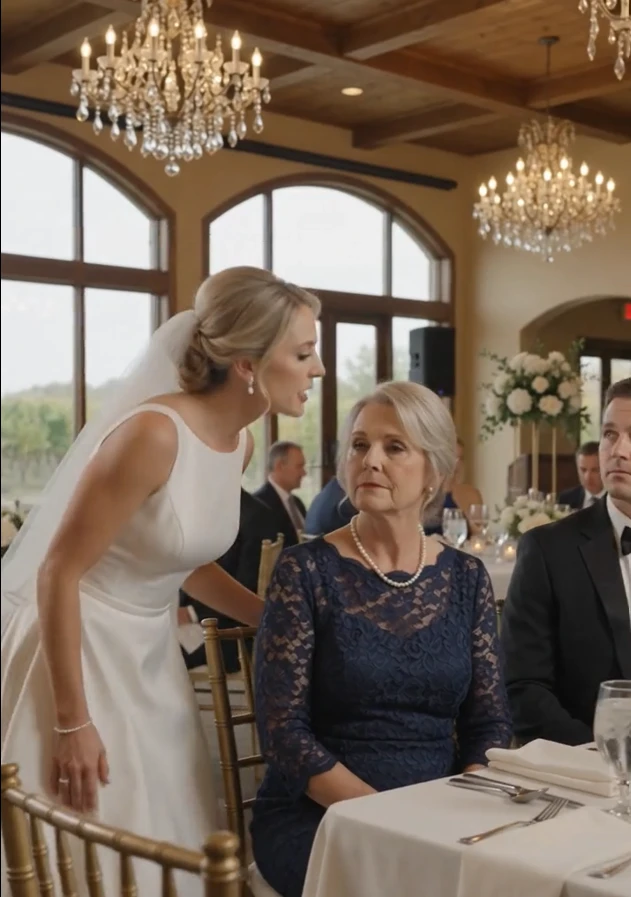
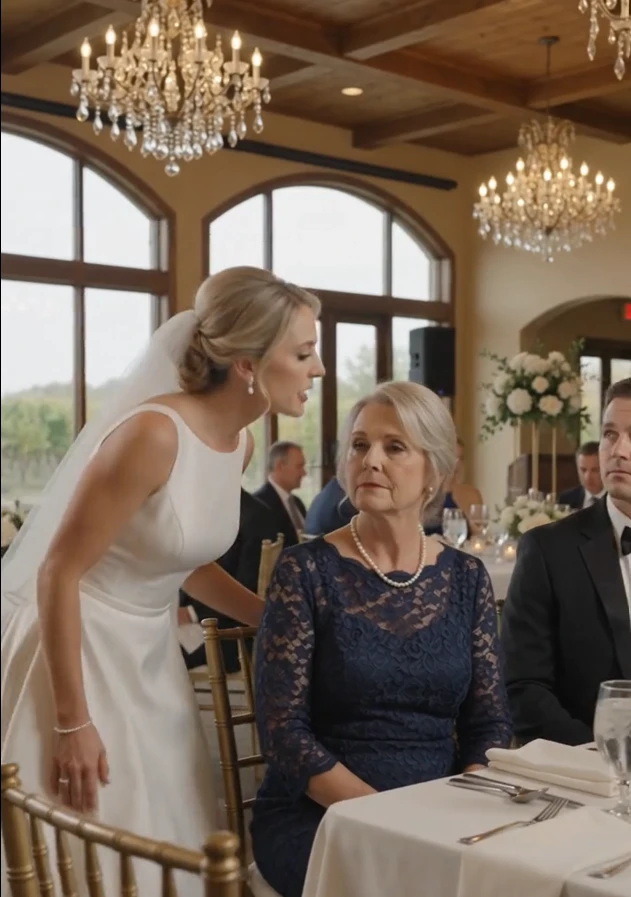
Amanda stepped closer, her white satin gown glowing beneath the vineyard chandeliers.
“Please leave. This isn’t your place.”
I looked at Jacob, waiting for him to defend the mother who had comforted him through every childhood nightmare. He never said, “Wait.” He never even called me “Mom.”
I quietly folded my napkin, rose from the table hidden behind a pillar, and walked toward the exit. But before leaving the reception hall, I made one call to the venue manager and handed him a signed letter from my purse.
Minutes later, the music stopped. The manager approached the microphone as two hundred guests turned toward him, and Amanda’s hand froze around her champagne glass.
“Before this reception continues, I have been instructed by the person who legally paid for and controls this event to announce—”
**The Wedding That Was Never Hers**
The vineyard glowed under strings of golden lights.
Two hundred guests sat beneath the chandeliers, champagne already poured, laughter already rising.
I sat at a table half-hidden behind a white pillar, the one they had given me after the seating chart was “adjusted.”
Amanda stepped closer.
Her white satin gown caught every light in the room.
She stopped three feet from my chair, smile perfect for the cameras that were no longer pointed her way.
“Please leave,” she said, voice clear enough for the nearest tables to hear. “This isn’t your place.”
I looked at Jacob.
The boy I had raised alone after his father walked out when he was four.
The boy whose nightmares I had sat through until dawn.
The boy whose college tuition, whose first apartment, whose engagement ring deposit had all come from the same quiet account.
He lowered his eyes.
He never said, “Wait.”
He never even called me “Mom.”
I folded my napkin with careful hands.
Rose.
And walked toward the exit without raising my voice.
Before I reached the double doors I stopped beside the venue manager, a man named Elias who had worked with me for six months on every detail of this night.
I handed him the envelope I had carried in my purse since the final payment cleared.
“Please read it now,” I said.
He opened it.
His face changed.
Two minutes later the music stopped mid-song.
Two hundred heads turned.
Amanda’s hand froze around her champagne glass.
Elias stepped to the microphone, voice steady.
“Before this reception continues, I have been instructed by the person who legally paid for and controls this event to announce the following.”
He cleared his throat.
“All vendor contracts for this wedding—catering, florals, lighting, band, photography, videography, and the vineyard venue itself—were signed and paid in full by Mrs. Eleanor Crowe. As of this moment, Mrs. Crowe has formally withdrawn her financial authorization for the remainder of the evening.”
A murmur rolled through the tent like wind through dry leaves.
“Furthermore,” Elias continued, “the open bar is closed. The second service of dinner will not be plated. The cake will not be cut. The band’s remaining sets are cancelled. Guests are welcome to finish what is already on their tables, after which the venue will begin breakdown.”
Amanda’s face went from porcelain to pure white.
Jacob finally looked up.
I was already at the edge of the dance floor when she found her voice.
“You can’t do this,” she hissed, loud enough for the front tables. “This is my wedding.”
I turned.
For the first time that night I spoke so everyone could hear.
“No, Amanda. This was the wedding I paid for. The flowers you insisted had to be imported. The band you refused to settle for less than. The custom lighting that cost more than my first car. The vineyard that required a two-year deposit. All of it sat on contracts with my name and my signature.”
I looked at my son.
“I raised you to be kind. I raised you to speak when someone was being cruel. Tonight you chose silence. That is your right. This—” I gestured at the glittering tent, the crystal, the perfect tables “—was never your right to take without consequence.”
Jacob stood.
His mouth opened.
Closed.
Amanda’s mother rose from the head table, face flushed.
“This is outrageous. You are humiliating your own son on his wedding day.”
I met her eyes.
“I was already humiliated. Publicly. By the woman wearing the dress I paid for, in front of the guests I fed. The difference is that I waited until I left the table before I answered.”
The band began packing their instruments with the speed of people who had just watched their paycheck disappear.
Servers stopped moving.
The cake—four tiers of white sugar flowers—sat untouched under its spotlight.
Amanda’s voice cracked.
“Jacob, say something. Make her stop.”
He looked at me then.
Really looked.
For a moment I saw the little boy who used to crawl into my bed during thunderstorms.
Then the moment passed.
“Mom,” he said, the word late and small, “please. Don’t do this.”
I felt the old ache, the one that had lived in my chest for years whenever he chose peace over truth.
“I already did,” I answered. “The moment she told me I had no place at the table I paid for, and you let her.”
I walked out into the cool vineyard night.
Behind me the tent erupted—voices rising, chairs scraping, someone shouting about lawyers, someone else crying.
I did not look back.
In the parking lot my phone buzzed.
A text from the florist.
“We received the cancellation. The remaining arrangements will be donated to the children’s hospital in the morning, as per your standing instruction.”
Another from the band leader.
“Understood. We’ll send the final invoice for services already rendered only.”
I sat in my car for a long time, hands on the wheel, the vineyard lights still glittering in the rearview mirror.
I had not planned the speech.
I had only planned the letter.
The letter had been enough.
Three days later Jacob appeared at my door.
He looked older.
Thinner.
He did not come inside at first.
We stood on the porch where he used to wait for the school bus.
“She left,” he said.
I waited.
“The night of the wedding. After everything shut down. She said I should have stopped you. She said I chose you over her. She took the gifts that were already opened and the cards with the checks still inside. Her parents called me a coward.”
He swallowed.
“I didn’t defend you because I was afraid of losing her. I lost her anyway. And I almost lost you for nothing.”
I looked at the son I had raised.
The silence stretched.
“I am not asking you to choose,” I said finally. “I am asking you to remember who stayed when no one was watching. Who paid when the invoices came. Who never asked for a public thank-you until the public thank-you was replaced with a public dismissal.”
His eyes filled.
“I’m sorry, Mom.”
The words landed softly.
I stepped aside.
“Come in. There’s coffee.”
He followed me into the kitchen that still smelled faintly of the cinnamon rolls I used to bake for him on Sundays.
We did not speak of Amanda again that afternoon.
We spoke of the years that had led us here—the quiet ones, the hard ones, the ones where I had signed checks and said nothing because I thought love was supposed to be invisible.
In the weeks that followed, the story travelled farther than the vineyard.
Guests who had watched Amanda’s face when the music stopped told their own versions.
Some called me vindictive.
Some called me overdue.
I did not answer any of them.
I only answered the one person who mattered.
One evening Jacob sat at my table again and said, “I want to start over. Not the wedding. Us.”
I reached across and covered his hand with mine.
“Then we start,” I said. “Without an audience. Without a bill that needs to be paid by someone who is then asked to leave.”
Outside, the sky darkened the way it does in late summer.
Inside, the house was quiet and warm.
No chandeliers.
No satin.
No two hundred witnesses.
Only a mother and the son she had raised, learning, slowly, how to look at each other without looking away.